
 +971 44 37 6484

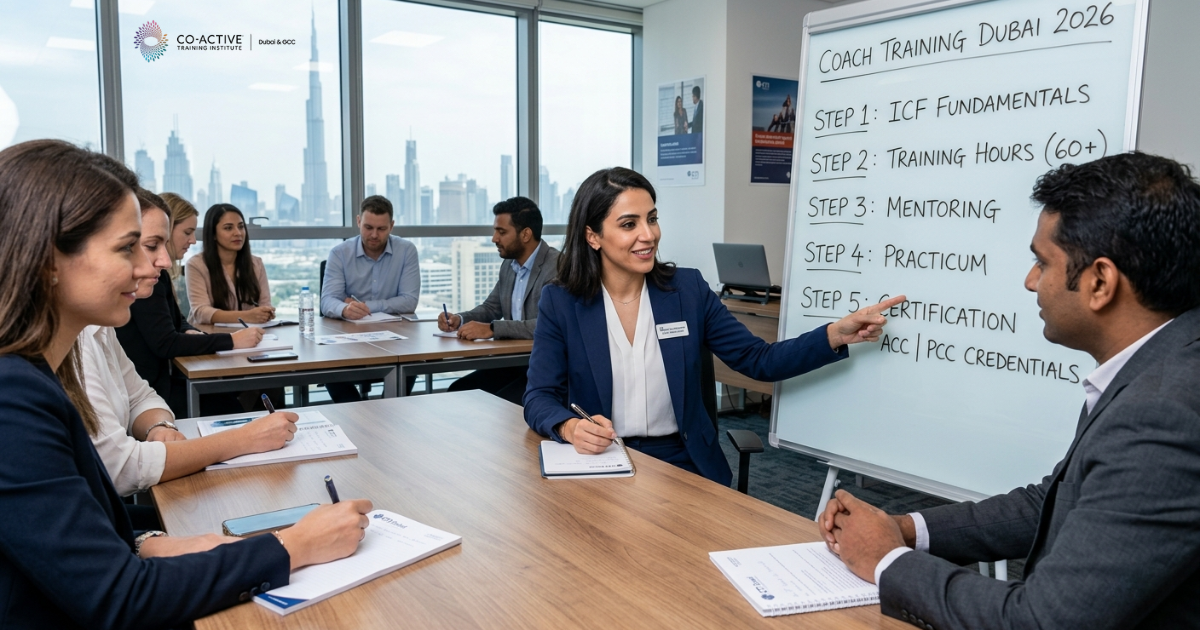
Becoming a certified coach in Dubai in 2026 requires completing an ICF-accredited program, tracking client coaching hours, undertaking mentor coaching, and passing the updated ICF Credentialing Exam. The premier regional pathway combines the globally recognized Co-Active (CPCC) designation with standard ICF credentials (ACC/PCC), offering flexible online or in-person training at Dubai Knowledge Park tailored for working GCC professionals.
quick Answer
The 2026 Dubai Coach Certification Roadmap
To become a certified coach in Dubai you must: (1) choose an ICF-accredited training programme, (2) complete the required coach-specific training hours (60+ for ACC, 125+ for PCC), (3) log supervised coaching practice hours, (4) complete 10 hours of mentor coaching, (5) pass the ICF Credentialing Exam, and (6) submit your ICF credential application. The most direct path in the region combines the Co-Active (CPCC) pathway with subsequent ICF credentials — all delivered from Dubai Knowledge Park or online for GCC-based professionals.
Dubai's coaching industry has shifted from a niche profession into a serious career pathway. Executive coaching, leadership development, life coaching — organisations from Emirates NBD to UAE government entities are now actively hiring credentialed coaches or asking their internal talent to carry recognised qualifications. If you're exploring this path in 2026, the landscape is more structured — and more rewarding — than it's ever been.
This guide cuts through the complexity. Rather than listing generic steps, it maps the actual decisions you face: which credential level to target first, which pathway fits your existing experience, and what the realistic timeline looks like when you're balancing this with a full-time role in the Gulf.
Not sure where you sit on the coaching certification ladder? The Co-Active Dubai team can map out your fastest route to an ICF-recognised credential.
Understand the three ICF credential levels
The International Coaching Federation (ICF) is the globally recognised body that sets professional coaching standards. In the UAE — particularly for coaches working with multinationals, government entities, and high-net-worth individuals — ICF credentials are what clients and procurement teams check first. There are three levels, each requiring progressively more training and client hours.
Associate Certified Coach
- 60+ training hours
- 100 client coaching hours
- 10 hrs mentor coaching
- ICF Credentialing Exam
- Ideal entry point
Professional Certified Coach
- 125+ training hours
- 500 client coaching hours
- 10 hrs mentor coaching
- ICF Credentialing Exam
- Corporate standard in UAE
Master Certified Coach
- 200+ training hours
- 2,500 coaching hours
- 10 hrs mentor coaching
- ICF Credentialing Exam
- Elite / specialist coaches
Most professionals starting out target the ACC first, then build toward PCC as their client hours accumulate. The CPCC pathway through Co-Active Dubai is ACTP-accredited — the ICF's highest programme approval level — meaning your training hours count in full toward any of these credentials.
The six steps to becoming a certified coach in Dubai
This is the practical sequence. Each step builds directly on the last — you can't shortcut step five without completing steps two through four.
-
1
Choose an ICF-accredited programme
This is the most important decision you'll make on the whole journey. An unaccredited programme — no matter how polished the marketing — means your hours don't qualify for ICF credentialing. In Dubai, Co-Active Training Institute holds ICF ACTP accreditation, the highest category. The accreditations and affiliations page lays out what this means in practice for your credential application.
-
2
Complete your coach-specific training hours
The Co-Active pathway begins with the Fundamentals course — you coach real people from session one, with faculty feedback throughout. Each subsequent module (Fulfillment, Balance, Process, Synergy) adds depth and practice hours. For ACC, you need 60+ qualifying training hours. PCC requires 125+. The programme calendar shows current intake schedules so you can plan around work commitments.
-
3
Accumulate client coaching hours
You start logging practice coaching hours alongside your training — not after it. For ACC you need 100 documented hours with real clients; PCC requires 500. Most Co-Active graduates begin coaching colleagues, managers, and paid clients before they finish the core modules. This parallel approach is what makes the 12–18 month timeline realistic rather than aspirational.
-
4
Complete 10 hours of mentor coaching
The ICF requires mentor coaching from a PCC or MCC-credentialed coach at every credential level. Co-Active Dubai's 6-month Certification Programme integrates supervised weekly live sessions — this is where your individual coaching identity crystallises and your hours toward mentor coaching and ICF PCC eligibility accumulate simultaneously. The coaching journey page maps how this phase connects to your overall pathway.
-
5
Pass the ICF Credentialing Exam
As of January 2026, the ICF updated its Minimum Skills Requirements (MSRs) for ACC and MCC performance evaluations, providing clearer benchmarks at each level. PCC format has been standardised for consistency. The exam tests applied knowledge of ICF core competencies and ethics — not memorisation, but genuine coaching understanding built across your training and practice.
-
6
Submit your ICF credential application
Once training hours, client hours, mentor coaching, and exam are complete, you submit your documented evidence to the ICF. Co-Active Dubai provides dedicated support for the ACC and PCC application process — the paperwork and hour-logging requirements can trip people up, and guidance from coaches who've been through it makes the process straightforward. Use the contact form to get specific guidance on your application readiness.
The Co-Active pathway: why it's the dominant route in the GCC
There are multiple ICF-accredited programmes available in Dubai. The Co-Active pathway stands apart for one practical reason: it's the only programme in the Middle East delivered with faculty who are themselves active practitioners at the highest certification level. You don't learn to coach from theory — you experience being coached and coaching others from the very first session.
CPCC credential
Co-Active's flagship designation. Recognised in 40+ countries, backed by Harvard Medical School's Institute of Coaching research, and ICF-ACTP accredited at the highest level. Completing CPCC puts you on a direct path to ICF PCC application.
Dubai Knowledge Park
CTI Dubai is the only dedicated in-person coaching training facility in the Middle East — based at Dubai Knowledge Park since 2005. The 6-month Certification phase runs fully online for professionals across the GCC.
The research backing matters when you're positioning yourself to serious clients. Harvard Medical School's Institute of Coaching has described the Co-Active model as congruent with a vast body of research in positive psychology. The American Council on Education recognises it for academic credit equivalency — relevant if your clients or employers ask about formal academic standing.
Ready to explore the CPCC pathway? Download the programme guide or speak with a certified faculty member — no commitment required.
CPCC vs other Dubai certification options: what actually differs
Choosing a certification programme is a long-term career decision. The differences that look minor on a brochure — accreditation level, learning methodology, faculty quality — have significant downstream effects on how clients and employers perceive your credential.
| What to compare | CPCC via Co-Active Dubai | Generic ICF Level 1 programmes | Short courses (under 3 months) |
|---|---|---|---|
| ICF accreditation level | ✓ ACTP — highest level | Varies (Level 1 or 2) | ✗ Often none |
| Learning approach | ✓ 100% experiential from day one | Mixed theory/practice | Mostly theory |
| Supervised certification phase | ✓ 6 months, live weekly | Limited mentoring | ✗ None |
| In-person option in UAE | ✓ Dubai Knowledge Park | Rare | ✗ Online only |
| Research validation | ✓ Harvard IOC backed | Varies | Typically none |
| Global alumni network | ✓ 140,000+ in 40+ countries | Smaller, regional | ✗ None |
| ICF PCC eligibility on completion | ✓ Direct application pathway | Possible, depends on programme | ✗ No |
Who gets certified — and what they do with it
A common misconception is that coaching certification is only for people who want to hang out a shingle and charge by the hour. In practice, roughly half of Co-Active graduates use their CPCC within an existing corporate role — as better leaders, more effective HR professionals, and managers who build teams that genuinely perform without micromanagement.
-
✓
Corporate leaders and senior executives — leading through coaching rather than command, building self-directed teams. The leadership development programme is specifically designed for this profile.
-
✓
HR and L&D professionals — building a genuine coaching culture inside an organisation, not just running training events. The organisation programme maps this pathway.
-
✓
Entrepreneurs and business owners — improving team leadership, client relationships, and personal decision-making under pressure.
-
✓
Aspiring professional coaches — building a private practice with credentials serious clients and corporates recognise immediately.
-
✓
Managers exploring the field — the Fundamentals course can be taken as a standalone workshop before committing to full certification.
I enrolled to strengthen my leadership approach — not to become a professional coach. What I got was a transformation I never expected. The Fundamentals course alone shifted the entire dynamic of my team.
Mohammed Al-Rashidi, HR Director, UAE Government — CPCC GraduateRealistic timelines for working professionals in the GCC
One of the most common questions from Dubai-based professionals: can I genuinely do this while working full-time? The honest answer is yes — if the programme is structured for it. Here's what the timeline actually looks like across different starting points.
| Your starting point | Recommended path | Realistic timeline | First credential |
|---|---|---|---|
| No prior coaching experience | Fundamentals → full CPCC pathway | 12–18 months | CPCC + ICF ACC/PCC |
| Existing ICF ACC credential | Join at advanced Co-Active modules | 6–9 months | CPCC + ICF PCC eligible |
| Manager wanting coaching skills only | Fundamentals standalone | 2–3 months | Co-Active Fundamentals certificate |
| Based outside UAE (GCC) | Virtual live format throughout | 12–18 months | Full CPCC + ICF credential |
The 6-month Certification phase runs entirely as live virtual sessions, meaning professionals based in Riyadh, Abu Dhabi, Doha, or anywhere else with a reliable connection complete the same supervised programme without disrupting their work schedule.
What's your current coaching experience level? The Co-Active team will map the exact modules you need and the fastest route to your target credential — typically a 15-minute conversation.
Why Dubai's coaching market rewards proper certification
The UAE has one of the most internationally mobile professional populations in the world. Clients — whether they're expat executives, Emirati business owners, or multinational HR teams — regularly move between Dubai, Singapore, London, and New York. A credential that only travels within the region is a liability. The ICF credential, with recognition in 140+ countries, is the standard that follows clients wherever they go.
For those targeting corporate coaching contracts specifically, the calculus is even clearer. Most large organisations in the UAE now specify ICF-credentialed coaches in their procurement criteria. Without a recognised credential, you're not in the conversation — regardless of your actual coaching ability. The certification isn't just validation; it's the entry ticket to the market segment that pays well.
Co-Active Dubai has trained coaches and leaders from organisations including Google, Emirates NBD, and multiple UAE government departments. That institutional track record matters when you're positioning your coaching practice — you're entering a community with existing credibility in the region's most serious organisations. Explore the Co-Active philosophy and history to understand why the methodology has earned that trust over 25 years.
Frequently asked questions
Do I need any prior coaching experience to start the programme?
No prior experience is required. The Fundamentals course is the starting point for everyone, and you begin coaching real people from your very first session with faculty feedback throughout. A genuine interest in how people grow — and a willingness to look honestly at your own patterns — matters more than any formal background.
What is the difference between a CPCC and an ICF credential?
The CPCC (Certified Professional Co-Active Coach) is Co-Active Training Institute's own credential, earned by completing the full five-course pathway plus the 6-month Certification Programme. ICF credentials (ACC, PCC, MCC) are awarded by the International Coaching Federation based on total training hours, coaching practice hours, mentor coaching, and a credentialing exam. Because the CPCC pathway is ICF-ACTP accredited, your hours count fully toward ICF credential applications — making CPCC the most efficient route to both designations. See our accreditations page for full detail.
Can I complete the programme if I'm based in Abu Dhabi, Riyadh, or elsewhere in the GCC?
Yes. While CTI Dubai's in-person option is based at Dubai Knowledge Park, the full 6-month Certification phase is delivered as live virtual sessions. Many graduates across Saudi Arabia, Qatar, Bahrain, and Kuwait complete the entire programme without relocating. The five core courses are offered in both in-person and live online formats — check the current schedule and pricing for upcoming intake dates.
How much does coaching certification cost in Dubai in 2026?
Training fees vary by module level, intake, and format (in-person vs. virtual). ICF application fees are charged separately by the ICF and depend on your credential level and membership status. The most accurate current AED pricing — including any available payment plans — is on the pricing page or available directly from the team by calling +971 44 37 6484.
What changed in ICF certification requirements in January 2026?
Effective January 1, 2026, the ICF updated the Minimum Skills Requirements (MSRs) for ACC and MCC credential performance evaluations — providing greater clarity on what proficiency looks like at each level. PCC requirements were not changed in substance, but the format was updated to align with the revised ACC and MCC documentation for consistency. If you started your training before 2026 with a programme that's ICF-accredited, your existing hours and completed steps remain valid under the updated requirements.
Can I take just the Fundamentals course without committing to full certification?
Yes — and many managers and HR professionals do exactly this. The Fundamentals course can be taken as a standalone and counts as the first step in the full CPCC pathway if you decide to continue later. Check upcoming workshops for the next available Fundamentals intake.
Is the CPCC recognised by employers and clients in the UAE?
Yes — and increasingly so. Co-Active graduates in Dubai have been hired or contracted by organisations including Emirates NBD, Google, Dior, and various UAE government entities. The CPCC combined with an ICF credential (ACC or PCC) is the pairing most corporate coaching procurement teams in the UAE look for first. For coaches building private practices, the CPCC's 40-country recognition means your credential travels with clients who relocate internationally.
Your coaching career starts with one conversation
Co-Active Dubai has been training the region's most credible coaches since 2005. Intakes are limited. Speak with the team today to find the right entry point for your background, timeline, and goals.